One of the gifts that comes with recalibrating your wisdom means you get to take the power back and choose how you wish to use your life energy to cultivate love, wisdom and healthy adult mode behavior in your life; this is truly empowering! No longer do you have to live by the “tyranny of the shoulds, musts and always” and any other maladaptive schema(s), schema mode(s), ego defense(s) or cognitive distortion(s), connected to Contaminated wisdom.
Recalibrated wisdom, the very wisdom God has always wanted us to live by, invites you to reconnect with the wisdom and purpose of the Shema, which was always intended to bless you, your inner parts (your Exile, Manager and Firefighter parts), and others (your neighbors, i.e. spouse, partner, family member, etc.) in your life.
Since Contaminated wisdom exposed you to behavior that adversely impacted your ability to attach and attune with others and enjoy the benefits of a life filled with secure attachment experiences, Recalibrated wisdom facilitates your ability to “earn” secure attachments by practicing solution-oriented behavior to nurture, feel safe, feel seen, feel soothed, and create security within yourself.
I’ve often thought of Recalibrated wisdom as life experiences which flow in this process: Recalibrate yourself (through the work you’re currently doing), which leads to a Rebirth of the heart, soul, spirit, mind and strength, which leads to a Regenerated life where you get to choose how you use your Reclaimed energy, which leads to Renewed life experiences and the Rewards of your labor. What are some of the rewards? Your ability to create and sustain Earned Secure Attachments and Attunement, which were foundational needs we needed when we were younger to effectively connect with ourselves and others, and, are skills that will serve us very well today, no matter how old we are.
So what follows are 25 strategies to assist you in your process of developing skilled behavior to learn how to build secure attachments and attunement within your person, in your effort to cultivate and benefit from this very healthy form of love in yourself. Integrate the “8 C” information in these 2 Wisdom Tools (“48 Strategies to get the most from the 8 Cs of Internal Family Systems” and “McGill’s 48 additional strategies to get the most from the 8 C’s of IFS,” both are the “1.5 – Loving Yourself” version) to enrich your process.
However, allow me to offer a word of encouragement about loving yourself: Some of you may need to give yourself permission “rewrite the old narratives in your mind and body that have been connected to contamination.” This is understandable, as old and outdated rules and roles connected to the “1.0” version of yourself and your past need to be revisited and replaced with loving and life-affirming “2.0” version upgrades, and often this is difficult to do. I encourage you to stay with your growth process, and don’t abandon nor regress to the contaminated past, but press on to cultivate, reparent and bless yourself with the practice of these principles that bring renewal to your 7 Core Areas as you engage in the exercise of Loving Yourself!
So in the words of Jeff Probst, host of the hit TV show “Survivor,” do you want to know what you’re “playing” for (and this is quite the reward!)? The blessings that accompany Attachment and Attunement solutions!
Attachment and Attunement: The Shema, Blessing and 8 C’s+ of Internal Family Systems Principles
This framework blends four key core components to build Recalibrated Wisdom (in the table below):
- The Shema Principles (Deut. 6:4–9): Blessings God has always wanted to give to you via your caregivers.
- The Blessing Principles: 5 practical and life affirming principles based on the Shema (Smalley and Trent, 1986, 2019).
- Internal Family System (IFS) “8 C’s”: Calmness, Clarity, Curiosity, Compassion, Courage, Confidence, Creativity, Connectedness.
- McGill’s “8 C’s” for our IFS: Consciousness, Care, Current, Choice, Collaboration, Communication, Celebration, Christ.
These four key components are suggested for you to integrate into your daily life to assist you to “rewrite and upgrade” your current operating system (love to your heart, soul, strength and mind, and how you love and treat others). When practiced, these wisdom behaviors will produce results that not only reflect you’re maturing and healing in your ability to create and maintain (earned) secure attachments and attunement, but you’re also strengthening your ability to develop grow healthy adult mode behaviors! Worth playing for? Survivors begin!
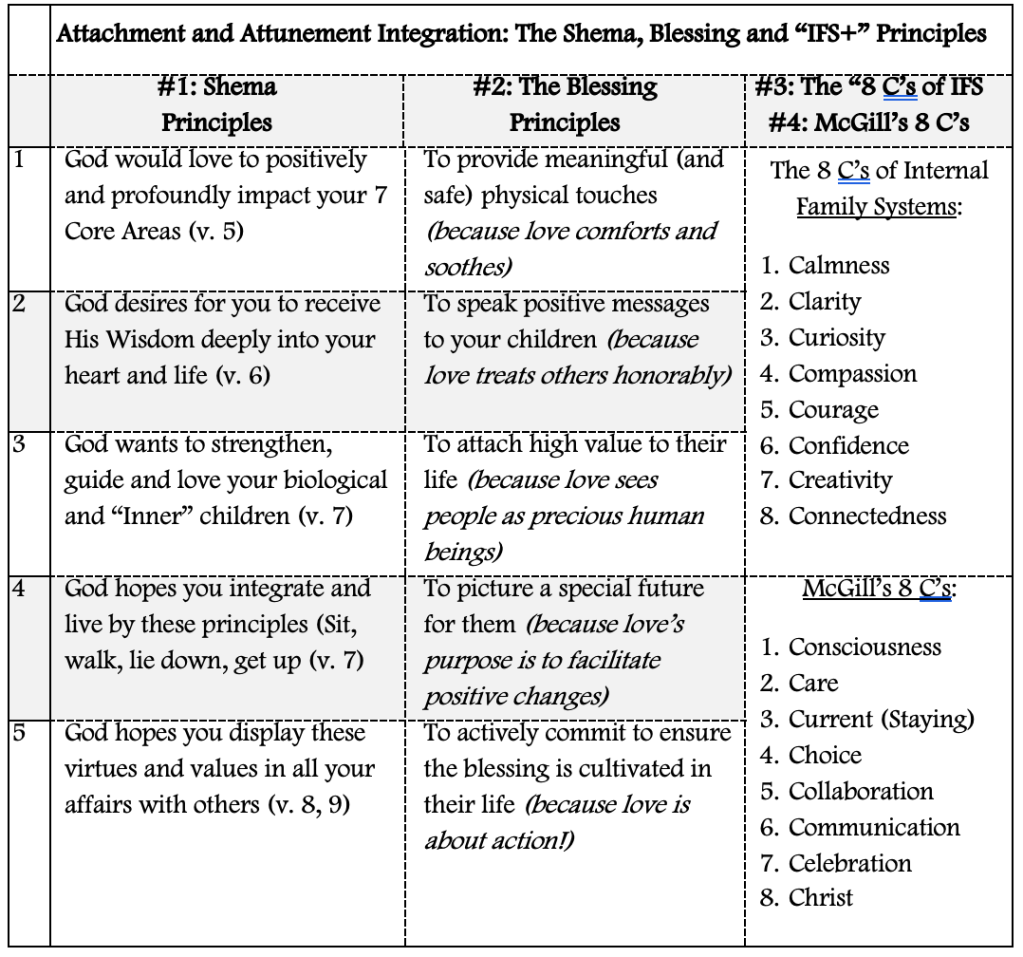
The 25 strategies below will refer to information in this table (i. e., “Shema #1” refers to Row 1, and Column 1; “Blessing #5” refers to Row 5 in Column 2). I encourage you to integrate these suggestions to work on Loving Yourself (1.5), and Loving your (Inner) Child/Children (1.5), because:
- Love cares about what occurs in your body (heart, soul, strength, mind and health).
- Love speaks life-affirming encouragement and it inspires and empowers us.
- Love encourages intentional and virtuous living, which is the best use of your life energy.
- Love produces a mindset of goal-directed focus, devotion, hope and yields valued outcomes!
Two final details as you begin: First, this is a two-part set of exercises. This one (along with the two 8 C’s Wisdom Tools) are focused on developing “1.5” (Love Yourself) solutions to do just that: Love Yourself. In three more subsequent posts, the focus will be on developing “2.0” (Love Your Neighbor) solutions, via 25 suggestions, and again two more 8 C Wisdom Tools to support your growth.
Second, personalize the suggestions and take what you can use and leave the rest! That’s it! Enjoy the fruit and outcomes of your labor as you Recalibrate your wisdom!
25 Strategies to cultivate Attachment and Attunement in Your Inner Parts
1. I hold a weekly space to listen to my inner parts and honor their feelings as a continuum of care. “I make a space to check in with my parts, allowing each one to express and feel heard. Every part deserves my time and presence, so I make (or visit my) sacred space to check in with love” (Shema #2; Blessing #5; 8 Cs: Collaboration, Celebration).
2. I create rituals of connection where my “inner family system” feels safe, loved, and invited into presence. “Engaging in rituals of self-connection like quiet awareness in the morning and gracious reflection in the evening are sacred, and they assist me in anchoring my parts to be here, be present and stay current. Practicing other spiritual disciplines like prayer, study and reflection helps me to build the inner security I need to function”(Shema #4; Blessing #4 and #5; 8 Cs: Connectedness, Christ, Current).
3. When a part bids for my attention, I respond with gentle communication and honoring presence. “When I feel restless or disconnected, I respond to those bids for attention with warmth, curiosity, gentleness and grace. I listen to, honor then respond to meet my need with grace, not judgment, and bring curiosity to my inner call for closeness”(Shema #4; Blessing #1 and #3; 8Cs: Communication, Care).
4. I communicate to my parts, “You matter and I’m here,” to establish safety through consistency and truth. “I repeat secure messages like “I am here with you” to create safety between my Self and my part, and my inner world grows safer each time I say ‘I am here with you, and I will not leave’” (Shema #2; Blessing #2; 8 Cs: Confidence, Communication).
5. I listen to each inner part with loving awareness, treating their voice(s) as a valuable contributor to my healing. “I practice listening to my emotions with curiosity and kindness, just as God listens to my heart; God listens to my heart with understanding and compassion, and I choose to do the same with every emotion I feel”(Shema #2; Blessing #2; 8 Cs: Compassion, Communication).
6. I build an emotional vocabulary that helps every part feel named, known, and honored in language and love. “I grow my emotional vocabulary so that every part feels seen, named, and understood; By expanding my emotional self-awareness, I create space where every part can be seen and named with love” (Shema #2; Blessing #2 and #3; 8 Cs: Communication, Consciousness, Choice).
7. I name my need, to be seen and loved with calm and clarity, and bless my longing as sacred and worthy.“I clearly name what my inner parts need: safety, connection, and being seen, and I bless those needs with dignity. Today, I realize my inner parts matter deeply to God and to me, so I take steps to validate, share and work toward need fulfillment”(Shema #1; Blessing #3; 8 Cs: Clarity, Consciousness).
8. When hurt arises, I respond with compassion and care, choosing words that soothe, not shame. “When I hurt inside, I speak gently to myself, offering words of truth and not blame. I offer gentleness to myself just as God’s voice always speaks compassionately to me, and never with criticism nor condemnation” (Shema #2; Blessing #2; 8 Cs: Compassion, Communication).
9. I name triggers without shame, bringing God’s wisdom to heal the echoes of old pain. “I name my triggers and bless the wounded parts they awaken, and the one who carries it, with wisdom, patience, and care, with no pressure and never shame” (Shema # 3; Blessing #3 and #5; 8 Cs: Clarity, Care, Christ).
10. When I feel anger, I get curious and ask myself “What sadness or fear are you protecting?” “When anger rises, I respond with gentle curiosity, and when I look within, I’ve found the scared or sad part of me that needs comfort”(Shema #1; Blessing #1 and #2; 8Cs: Curiosity, Consciousness).
11. I reframe anger as a signal from within and meet it with curiosity and healing intent. “I notice when a reactive part shows up and I’ll ask myself ‘What’s the emotion beneath this anger?’ with compassion. I’ll pause and say to inner part ‘your pain is valid; I see you, and I’m listening.’”(Shema #3; Blessing #1 and #3; 8 Cs: Curiosity, Consciousness).
12. I affirm my efforts to stay connected with courage and celebration, even when it’s hard. “I affirm my inner courage: ‘You’re showing up with love, and that’s a sacred act, and every act of inner courage is empowering; so when you show up in love, I bless and cherish the healing that’s happening inside of me.”(Shema #3; Blessing #2 and #3; 8 Cs: Connection, Courage, Celebration).
13. When shame spirals rise, I ground myself in current awareness and bless the vulnerable part with peace. “I gently interrupt cycles of shame by grounding myself in God’s peace and bless by embracing the overwhelmed parts within me. Even when shame floods in, I visit my safe place and center myself in God’s peace and respond to my overwhelmed parts with tenderness, curiosity support and understanding”(Shema #4; Blessing #1 and #5; 8 Cs: Current, Care, Curiosity).
14. I co-regulate with my parts using breath, physical care, and spiritual stillness that invites peace.“I regulate with breath, touch, Wisdom tools, and the use of other spiritual disciplines, inviting God to bring calm and to restore peace in my brain and throughout my body”(Shema #1; Blessing #1; 8 Cs: Calmness, Care, Christ).
15. Before reacting, I pause, breathe, and reconnect with God’s calm presence in my system. “Before responding to inner conflict, I pause to breathe, honoring my parts with calm instead of control. By choosing calm over control, I breathe peace into my system and invite God’s wisdom to guide me; The P-T-A Tool (Pause – Think – Act) is wonderful for helping me to accomplish this.”(Shema #1; Blessing #5; 8 Cs: Calmness, Christ).
16. I gently interrupt patterns of inner pursuit or withdrawal, offering calm connection instead. “I notice when a part withdraws or pursues and say, ‘I see you and I won’t abandon or overwhelm you; you don’t have to protect or hide, I am here’” (Shema #4; Blessing #1 and #5; 8 Cs: Calmness, Compassion, Collaboration).
17. I explore my inner history with God-centered curiosity and bless the resilience found within it. “I revisit my story with sacred curiosity, honoring both pain and resilience in every part that I discover or show up. Today I explore my story without shame, and I take the opportunity to pause, explore and welcome every part with the reverence of one made in God’s precious image” (Shema #3; Blessing #3; 8 Cs: Curiosity, Christ).
18. I speak directly to shame-based narratives with Christlike compassion. “I speak against inner lies with love: ‘You are not too much; you are wonderfully made and deeply loved.’ So when the lie arises inside, I meet them with truth and compassion that affirms my life and my right to be perfectly imperfect” (Shema #2; Blessing #2 and #3; 8 Cs: Compassion, Christ).
19. I repair internal ruptures with grace and soft starts, reminding my parts they are never disqualified from love. “When rupture happens inside, I repair with kindness; I speak healing over rupture: ‘You are still mine, still loved, even in this mess”(Shema #2; Blessing #5; 8 Cs: Compassion, Celebration).
20. I set firm but kind boundaries that protect inner peace while honoring my parts’ emotions and stories. “I set clear boundaries with protective parts, assuring them their worth isn’t in overworking or shutting down. I lovingly guide my protective parts, reminding them their worth is not in what they do but in who they are”(Shema #2; Blessing #1 and #5; 8 Cs: Clarity, Care, Connectedness).
21. I build trust in myself by choosing daily collaboration and returning again to show up with love. “I build trust in myself by taking time to be reliably present for my parts each day: “Trust grows as I keep showing up for my parts each day, with kindness, consistency and care”(Shema #4; Blessing #5; 8 Cs: Courage, Collaboration, Choice).
22. I celebrate every step toward earned secure attachment, knowing every moment of love I give to myself helps to rewrite and replace my old inner narrative. “I celebrate each internal moment of growth with grace, praise and gentle delight. This is exciting because my choices to cultivate a new me and how I wish to live as a healthy adult are paying off” (Shema #4; Blessing #4; 8 Cs: Choice, Creativity, Celebration, Confidence).
23. I lead myself with loving courage, choosing faithfulness to wisdom over fear or fragmentation. “I choose to love and be motivated by love rather than fear-based reactivity. When I do this, my actions reflect I’m living by wisdom rather than (perpetuating) woundedness, which is one of the better uses of my life energy”(Shema #1; Blessing #5; 8 Cs: Creativity, Courage, Choice).
24. I align my daily thoughts and actions with God’s values, blessing my system by living in integrity. “I align my inner system with my God-given virtues and values and be gracious for the energy expenditure and effort it takes to live in integrity; this does my heart well!” (Shema #4; Blessing #4 and #5; 8 Cs: Choice, Christ, Clarity).
25. Every day I reassure my parts: “You are safe with me, and we are growing in love together.” “My choice to cultivate love as evidenced by being safe creates confidence and collaboration with my inner parts. Together, we are recalibrating wisdom and though each day carries it’s own challenges, living wisely gives me confidence that we will make it through” (Shema #1 and #4; Blessing #1 and #5; 8 Cs: Connectedness, Christ, Confidence, Courage).
Thanks for reading this excerpt from Cultivating Love: Wisdom for Life. As time permits, please visit the other blogs written by Dr. Ken McGill: Daily Bread for Life and “3–2- 5–4–24” for additional information that could be helpful.
 drkenmcgill.com